
Blog
Welcome to our blog where we explore news, policy developments and best practice ideas relating to how parents and carers can fully meet their work and caring responsibilities, and how their employers can best support them.
In the interests of open debate and the exploration of new ideas, any views expressed here may not necessarily represent the formal view of Working Families.

A new, values-driven visual identity
We are delighted to launch our new visual identity today. As the UK’s national charity for working parents and carers, it’s vital that our brand helps to drive our mission and reflects the people and employers we work with every day. We have developed our new look and feel to support our objectives of empowering working parents and carers, supporting employers, and driving meaningful policy change.

How employers can help their people weather the cost-of-living storm
This guide, shaped by some of our progressive employer members, offers advice and practical actions employers can take to provide support to those who most need it. The cost-of-living crisis presents huge challenges, but also an opportunity for employers to think creatively and do things differently that may provide long-term benefits.

Carers Week 2023
Caring for loved ones can be a challenging role which deserves recognition and support in the workplace. Fortunately, there are many employers out there pouring time and effort into creating environments where carers can be open about their needs. Carers Week is a great opportunity to shout about some of our previous Best Practice winners who are doing just that.

Be part of a major new research study on workplace support for expecting and new parents in small and medium-sized enterprises (SMEs)
Working Families is excited to be part of a new large-scale research study on workplace support for new parents in small and medium-sized enterprises (SMEs). The research team, which involves researchers from the Universities of Middlesex, Manchester and Leeds, as well as Working Families and the Fatherhood Institute, is currently looking for both employer and employee participants.

Working Families Index 2023 – Spotlight report
The last few years have been hard on all parents. But for those on a low income managing the spiralling cost of living, life has been especially tough. A lack of affordable childcare, soaring energy prices and other skyrocketing living costs have created a perfect storm in which lower-income families are in the eye of.
Mental Health Awareness Week
Mental health is something we should all care about, all year long. But Mental Health Awareness Week provides a great opportunity for us to share some of the progressive practices that some of our previous Best Practice Award winners have put in place to support employees.

A force for good: How Pinsent Masons’ partnership with 2023 Working Families Index will benefit business practices and beyond
Pinsent Masons is the official Working Families Index 2023 partner. They're dedicated to flexible and family friendly working, driving change for employers across the UK.

Sponsorship case study: Bright Horizons
Bright Horizons is our sponsor for this year’s National Work Life Week. Working Families and Bright Horizon share a long history of partnership working. We asked them about their experience being a valued Working Families sponsor.

Address the stress: how to take action to reduce work-related stress, and why
Based on our work with employers to embed flexible working practices, we’ve put together some suggestions for actions that employers can take to help reduce stress at work

When two heads are better than one – top tips for job sharing
Job sharing is a fantastic way to unlock flexibility, especially in senior roles. We were lucky enough to spend some time talking to senior civil servants Ruth Hannant and Polly Payne about how they've made their job share a success for over 13 years.

Do the new childcare proposals have what it takes to solve the childcare crisis?
We welcome the acknowledgement by the Government that families are struggling and the current system is failing parents and carers who find themselves unable to make work, work. But, as with all policy announcements, the devil is in the detail.
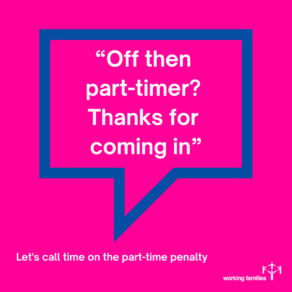
“She
onlyworks part-time” – Let’s call time on the part-time penaltyPart-time work is predominantly women’s work. It is undertaken by 38% of women, compared to 11% of men, very often so they can manage looking after their family. Working around caring commitments makes it the least flexible ‘flex’, and until the burden of care is shared more equally, women’s careers will continue to pay the price.